


Kinetophone film ‘Nursery Favorites’ an early Edison ‘talkie’
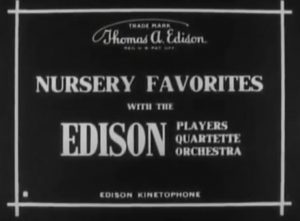 The 1913 Edison kinetophone film Nursery Favorites will be one of three films shown on April 22 on the lawn of Henry Ford’s winter residence on the banks of the Caloosahatchee River. One of more than 200 sound films released in 1913 and 1914, Nursery Favorites brings everyone’s favorite Mother Goose characters to life.
In the era of silent films, Edison and his staff began experimenting 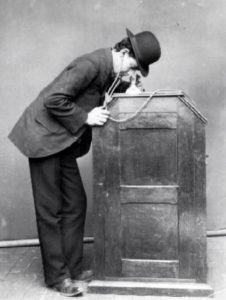 with a device to synchronize sound and moving pictures. In fact, Thomas Edison spoke of making “talkies” as early as 1890, but it took more than twenty years to develop the requisite technology.
In 1910, Edison introduced a disc-based synchronized sound system, but it was not even close to commercially viable. He quickly replaced the disc with a cylinder.
His new-and-improved “kinetophone” was unveiled in New York in February of 1913. For the first time, filmmakers were able to record the performers simultaneously on film and an adjunct sound device.
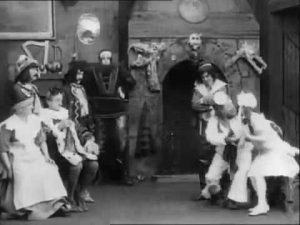
An example of one 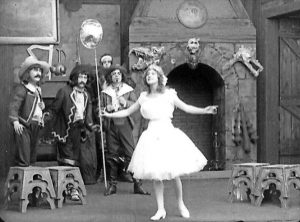 of these early kinetophone productions is Nursery Favorites, a loosely-plotted single-shot motion picture that features Miss Muffet, the Queen of the Fairies, Jack the Giant Killer and a number of other characters from Mother Goose. In fact, you’ll notice that the actors do little more than walk onto a small, cramped sound stage to recite their lines and sing and dance.
 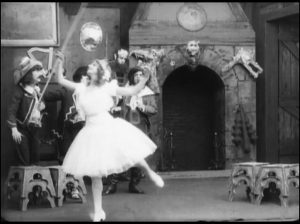 The whole film takes less than six minutes, which was the total amount of recording time afforded by a cylinder.
In the iconic Gene Kelly-Debbie Reynolds film Singin’ in the Rain, there’s a scene in which a screen test audience openly mocks and ridicules R.F. Simpson’s first attempt to produce a talkie following the release of The Jazz Singer. Their laughter emanated 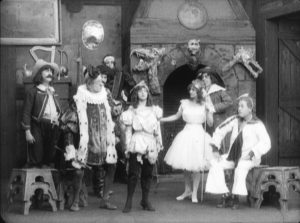 from a number of causes, including Lina Lamont’s squeaky voice and Don Lockwood’s inept acting. But what prompted the greatest derision was the filmmakers’ inability to match the voices with the movement of the actors’ lips and mouths. This sequence was based in fact. Audiences often guffawed derisively during early talkies because the sound was either too fast, too slow or delayed by
  several seconds.
Some studios solved this problem by recording the sound separately and then having the actors lip synch their lines. But Edison was not wont to take shortcuts. However, his efforts to solve sound synchronization and related projection problems was dealt a fatal blow on December 9, 1914, when fire swept through his research facility in West Orange, New Jersey. 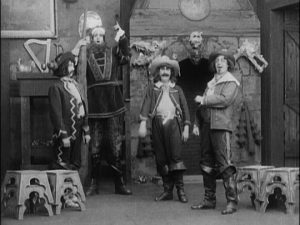 In all, the fire claimed eleven buildings, severely damaged two others and incinerated all of Edison’s Kinetophone masters. At 67 and with the European market pre-empted by war, Edison abandoned further research and development and bowed out of the film industry altogether.
Nevertheless, Nursery Favorites is a fascinating moment in the history 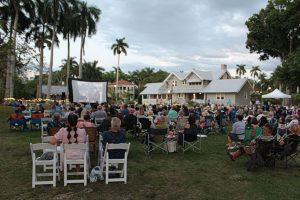 of “talkies” and an important part of the filmography of Fort Myers’ favorite winter resident, Thomas Alva Edison.
April 3, 2022

About the Author
 Tom Hall is both an amateur artist and aspiring novelist who writes art quest thrillers. He is in the final stages of completing his debut novel titled "Art Detective," a story that fictionalizes the discovery of the fabled billion-dollar Impressionist collection of Parisian art dealer Josse Bernheim-Jeune, thought by many to have perished during World War II when the collection's hiding place, Castle de Rastignac in southern France, was destroyed by the Wehrmacht in reprisal for attacks made by members of the Resistance operating in the area. A former tax attorney, Tom holds a bachelor's degree as well as both a juris doctorate and masters of laws in taxation from the University of Florida. Tom lives in Estero, Florida with his fiancee, Connie, and their four cats.